

Steps to Develope Decision Table
- Show sets of conditions and the actions.
- Logic can be easily expressed in a table format.
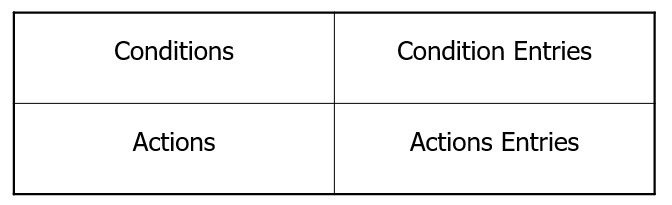
- Draw boxes for the top and bottom left quadrants.
- List the conditions in the top, left quadrant. When possible, phrase the conditions as questions that can be answered with a T for yes and an F for no. List the possible actions in the bottom, left quadrant.
- Count the possible values for each condition and multiply these together to determine how many unique combinations of conditions are present:
- For example, if there are two conditions and the first condition has two possible values while the second has three possible values, draw six (2 * 3) columns.
Decision Table Example 1
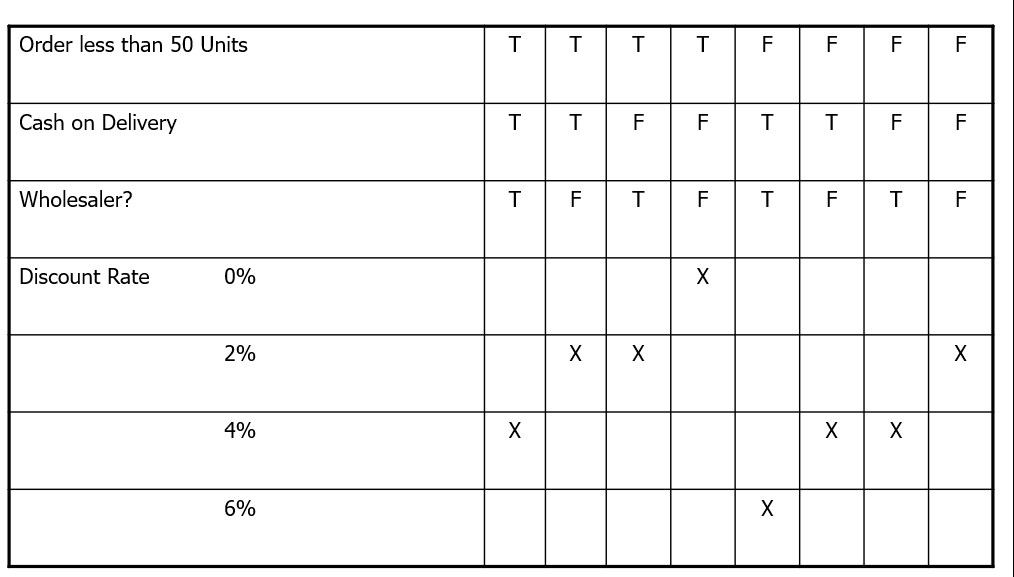
- Company X sells merchandise to wholesale and retail outlets. Wholesale customers receive a two percent discount on all orders.
- The company also encourages both wholesale and retail customers to pay cash on delivery by offering a two percent discount for this method of payment.
- Another two percent discount is given on orders of 50 or more units. Each column represents a certain type of order.
Decision Table Example 2
New Tax will be applied depending on following Condition :
- Income less than 1200, not married , younger than 35, tax=15%
- Income less than 1200, married , younger than 35, tax=10%
- Income less than 1200, not married , older than 35, tax=5%
- Else 15%

Decision Table Questions
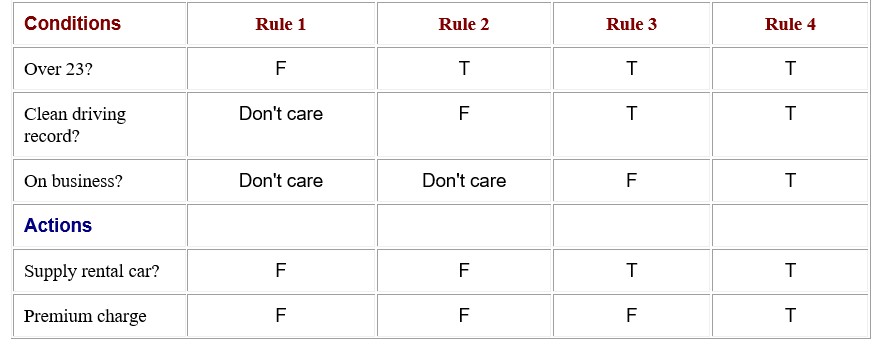
1. Consider the following decision table for Car rental and check what will be the expected result for the following test cases?
TC1: A 26-year-old on business but with violations or accidents on his driving record
TC2: A 62-year-old tourist with a clean driving record
A. TC1: Don’t supply car; TC2: Supply car with premium charge.
B. TC1: Supply car with premium charge; TC2: Supply car with no premium charge.
C. TC1: Don’t supply car; TC2: Supply car with no premium charge.
D. TC1: Supply car with premium charge; TC2: Don’t supply car.
2. Given the following decision table: Which of the following test cases and expected results is VALID?
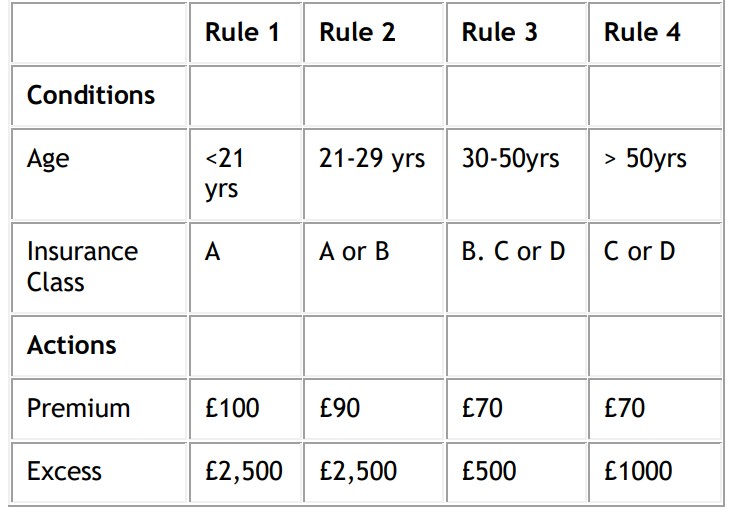
A. 23 year old in insurance class A Premium is £90 and excess is £2500.
B. 51 year old in insurance class C Premium is £0 and excess is £00.
C. 31 year old in insurance class B Premium is £0 and excess is £500.
D. 43 year old in insurance class C Premium is £0 and excess is £000.